


totara

A complete banking platform

Banking technology, built for the institutions that put customers first.

Credit unions, mutuals, and smaller banks deserve the technology the big banks have. Totara delivers it — modern customer app, governance built in, transparent pricing, migration handled — as one integrated platform.

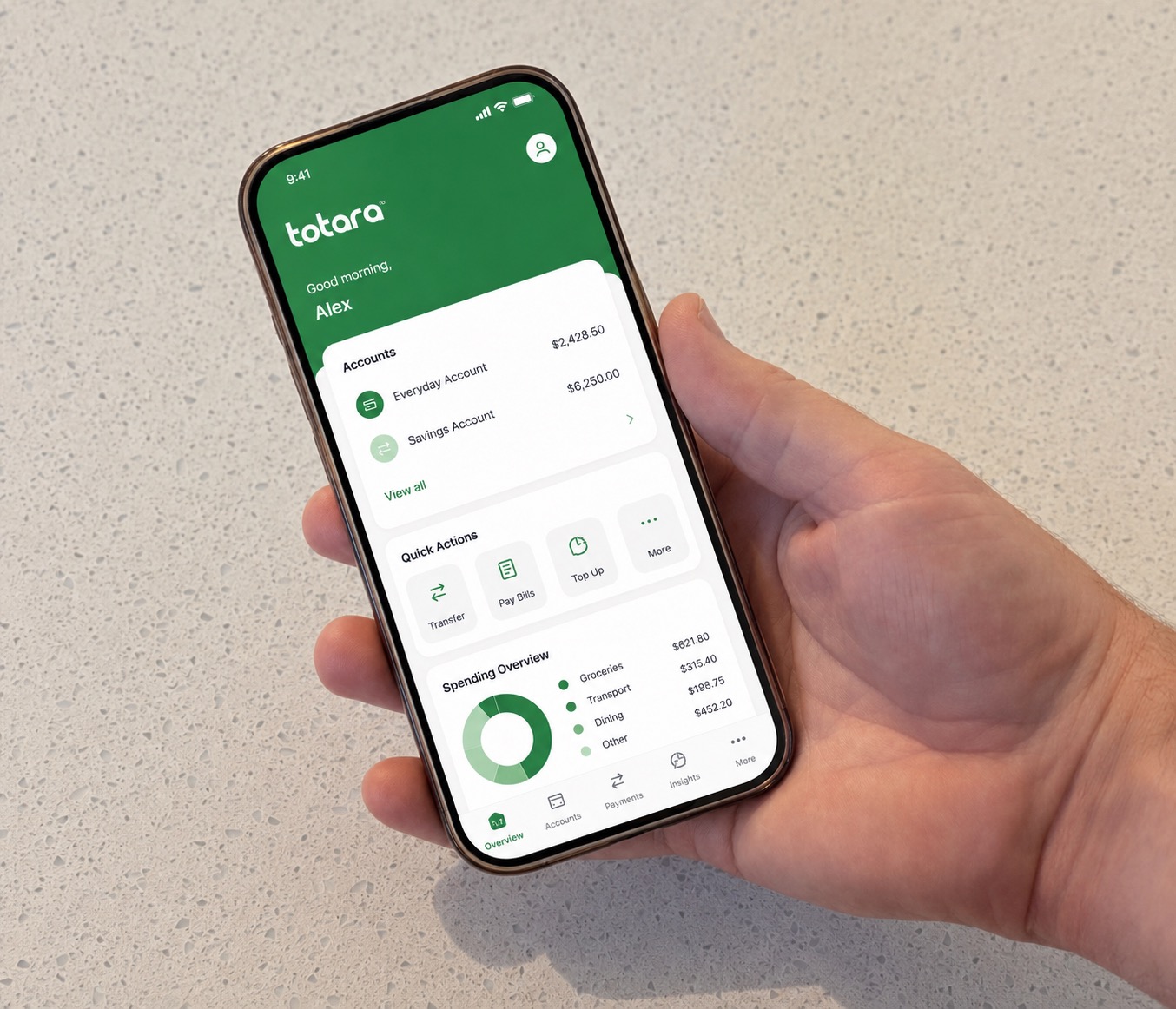
Totara banking app on a phone, showing accounts and quick actions

01 — Customer Experience

The best banking app your customers will ever use.

Banking apps have become afterthoughts — built around what the core system can expose, not what the customer actually needs. Totara starts from the other end. We designed the customer experience first, then built the platform underneath to deliver it.

The result is a banking app that's clean, fast, and uncomplicated on the surface — and unusually deep underneath. Customers see spending categorised automatically, savings tracked against goals, and patterns surfaced before they need to ask. An AI financial assistant answers questions, suggests adjustments, and quietly handles the routine work that used to need a phone call.

Most things customers used to ring a call centre for, they now do themselves in under thirty seconds.

Modern banking app showing accounts, quick actions and spending overview

Modern, mobile-first banking app

Built once, shipped to every customer.

Automatic insights

Transaction categorisation and personal spending patterns surfaced automatically.

AI financial assistant

Proactive help rather than waiting to be asked.

Maximum self-service

Customers handle the day-to-day; your team handles what genuinely needs a person.

Simplicity on the surface

Real capability underneath. Clean interface, deep platform.

02 — Governance by Design

Compliance isn't bolted on. It's the foundation.

Most banking platforms treat regulation as something the customer has to layer on top — separate teams, separate tools, manual reporting, constant catch-up every time the rules change. Totara was built the opposite way. Every regulatory obligation is mapped to a policy, every policy to a control, and every control to the part of the platform that enforces it automatically.

That means the New Zealand Deposit Takers Act (2023) is already in the platform. APRA's CPS 230 operational risk standard is already in the platform. AUSTRAC, RBNZ, FMA and ASIC reporting flows are already in the platform. So are the UK PRA Rulebook and FCA conduct framework, the EU's CRR / CRD prudential framework, the Basel III pillars, and the FATF AML standards — alongside the local rules that apply in every other jurisdiction we operate in. As the rules change, the platform changes — once, centrally, for every customer.

A governance dashboard gives you a live view of compliance against the regulation that applies to you, in the jurisdiction you operate in. Manual oversight is reserved for the exceptions and the decisions the regulator requires a human to make. Everything else happens by itself.

Regulation built in

NZ Deposit Takers Act, APRA CPS 230, UK PRA & FCA, EU CRR/CRD, Basel III — plus the local framework that applies wherever you operate.

Policy → control mapping

Every obligation linked to a policy, with automated controls wherever possible.

Live governance dashboard

Real-time assurance, not retrospective reports.

Exception-based oversight

Manual work only where the regulation requires a human.

Regulatory change as platform update

Once, centrally, for every customer. Not a bank-side project.

03 — A Complete Banking Platform

Everything you need to run a bank. In one platform.

Modern banks typically run six or more systems to deliver what their customers expect — a core, a payments stack, a KYC and AML platform, an analytics and risk environment, a customer app, a back-office console, plus integration glue holding it all together. Each one has its own vendor, its own roadmap, its own contract, its own bill, and its own seam where things go wrong.

Totara is one platform. The core ledger, KYC and identity, AML monitoring, payments processing, credit decisioning, analytics and risk, the data infrastructure, and the customer and back-office apps are designed and built as one system. They share a data model, an event bus, and a governance layer. They ship together, upgrade together, and stay in sync without effort on your part.

The customer-facing app — modern, mobile-first, best in class — is included, not a separate purchase.

Traditional stack

Six vendors. Integration glue. Drift.

  • Core ledger
  • Payments
  • KYC / AML
  • Credit
  • Analytics
  • Customer app

+ integration glue

Totara platform

One system. One data model. One upgrade.

Core
Payments
KYC & AML
Credit
Risk & analytics
Customer app
Back office
APIs

Shared data model · Event bus · Governance layer

One integrated platform

The full breadth of retail and SME banking, in a single system.

No integration projects

No multi-vendor finger-pointing, no version mismatches.

Customer app included

Best-in-class banking app as standard, not a separate purchase.

One contract, one upgrade

One vendor, one team, one upgrade cycle.

Designed, not assembled

A coherent system, not a collection of vendors held together with glue.

04 — Transparent Cost

You pay for your customers. That's it.

Banking platform pricing is usually opaque on purpose — base licence, module licences, transaction fees, integration fees, change requests, and a list of 'additional capabilities' priced separately. Six months in you've spent twice what you budgeted, and the cost only goes one way.

Totara pricing is simple. You pay per customer, per facility. The full platform is included — every module, every integration, every regulatory feature, every upgrade. There are no separate fees for the customer app, the AML engine, the credit decisioning platform, or the analytics layer.

Two things sit outside that per-customer price, and we disclose them up front: cloud infrastructure usage is passed through at cost, and bespoke professional services (custom migrations, integrations with non-standard external systems) are scoped separately when you need them. Everything else is included.

The number scales cleanly with your business. When you have more customers, you pay more. When you don't, you don't.

In your per-customer price

All included
  • Core banking ledger
  • Payments & transfers
  • KYC & identity
  • AML monitoring
  • Credit decisioning
  • Risk & analytics
  • Customer app
  • Back-office console
  • APIs & integrations
  • Regulatory compliance
  • Platform upgrades

Disclosed separately

  • Infrastructure usage

    Cloud and processing costs are passed through at cost. No markup.

  • Professional services

    Bespoke migrations and non-standard integrations are scoped separately when you need them.

Per customer, per facility

One transparent price that scales with your business.

Full platform included

Every module, every integration, every regulatory feature, every upgrade.

Pass-throughs disclosed

Infrastructure at cost. Bespoke services scoped separately. Nothing buried.

Predictable economics

The number scales cleanly. More customers, more value.

One price, published

Clear pricing, clearly stated. Not a negotiation.

05 — Lower Operating Cost

Stop spending half your budget keeping the platform alive.

The hidden cost of a traditional banking stack isn't the licence fees. It's the people. Compliance teams reconciling reports by hand. Operations teams managing exceptions that should never have been exceptions. IT teams patching integrations between systems that were never designed to talk to each other. Risk teams pulling data from four sources to answer one question.

Totara automates the work that doesn't need a human and surfaces the work that does. Reconciliation is continuous. Regulatory reports build themselves. Compliance dashboards are live, not assembled. Exceptions route to the right person, with the context already attached. The platform takes care of itself.

That frees your team to do the work only your team can do — looking after your customers, growing your business, and shaping the products your members actually want.

Traditional stack

Manual · siloed

  • Reconciliation
  • Regulatory reporting
  • Compliance monitoring
  • Exception management
  • Systems & integrations

Totara platform

Automated · integrated

  • Reconciliation
  • Regulatory reporting
  • Compliance monitoring
  • Exception management
  • Systems & integrations

Illustrative. People-density per function on a traditional banking stack vs Totara — your numbers will vary.

Continuous reconciliation

Regulatory reporting and compliance monitoring run automatically.

Exception-based operations

People work on what matters, not on what should already be done.

Self-maintaining platform

Less time keeping the lights on, more time doing the work.

Lower back-office headcount

Reduced load in compliance and operations functions.

Team focus

Your people look after customers, not after the platform.

Operating cost over time

Illustrative. The shape of each line is the point.

Traditional stack Totara platform
$ 0 Time / scale →

Totara costs less than a traditional stack from day one — and stays on a linear curve as you scale. Traditional stacks compound cost: more customers means more people, more reconciliation, more integration work.

06 — Built for Smaller Financial Services Companies

World-class banking technology, built for institutions your size.

Building societies, credit unions, mutuals, and smaller banks are doing some of the most important work in financial services — serving members, supporting communities, lending to people the big banks won't. But they're competing against banks twenty or fifty times their size, on technology budgets a fraction of what those banks spend.

Totara exists because that gap shouldn't have to exist. The same platform capability that powers a global tier-one bank — modern customer app, automated compliance, real-time risk and reporting, full lending and deposit product set — is available to a mutual with a few hundred million dollars on the balance sheet, at a price that fits the business model.

You don't need to grow into the technology. The technology fits the scale you're at today, and grows with you.

A small community-bank branch alongside a modern banking dashboard

Built for mutuals and smaller banks

Designed specifically for building societies, credit unions, mutuals.

Big-bank capability

The technology the tier-one banks have, at a price you can sustain.

No compromise

Stay affordable without compromising customer experience or compliance.

Scales both ways

Fits your size today, grows without re-platforming.

Built by sector insiders

By people who understand mutuals and what they stand for.

07 — Migration

The hard part of replatforming, made tractable.

Moving off a legacy banking platform is the single biggest reason institutions don't move. The data is messy, the rules aren't documented, the staff have years of muscle memory, and the risk of getting it wrong is existential. Most platform vendors treat migration as the customer's problem.

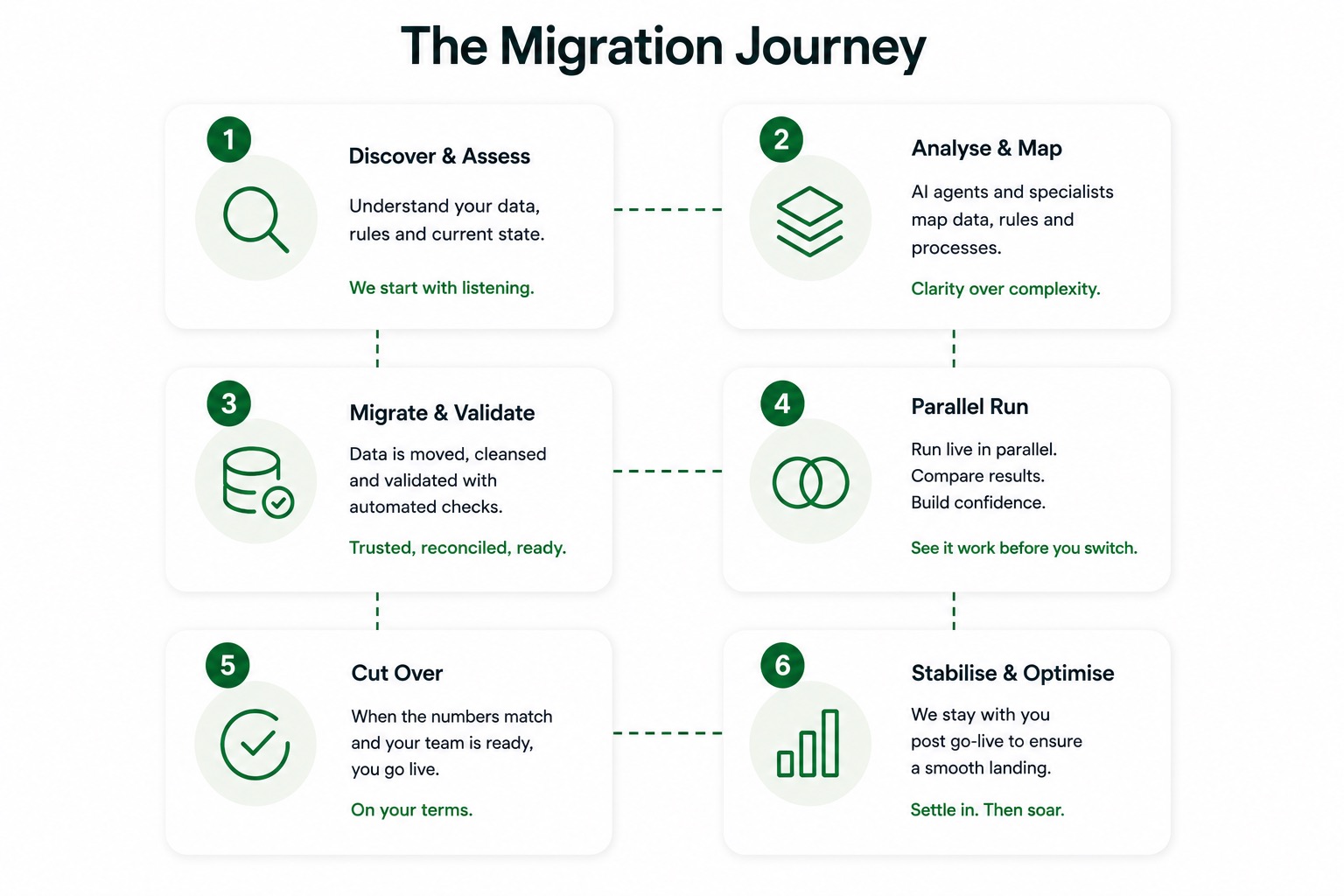
Totara treats it as ours. We've built the platform around migration from the start — data tooling, AI-powered agents that accelerate the analysis and mapping work, and a deeply experienced migration team that lives and breathes data. Your data is moved across, validated, and reconciled. The new platform runs in parallel with the old one while you watch the numbers match. Your operations team learns the new system before anything switches over.

When you're ready — and only when you're ready — you cut over with confidence, because you've already seen it work.

Side-by-side comparison of legacy and Totara systems with reconciled balances

Designed in, not bolted on

Migration is part of the platform, not an afterthought.

AI-accelerated analysis

Agents speed up data analysis, mapping, and validation.

Experienced migration team

People who live and breathe banking data.

Parallel running

See the new platform working before you commit to it.

Cut over on your schedule

You go live when the numbers match and your team is ready.

A proven migration journey

  1. 1

    Discover & assess

    Understand the existing data, rules, and current operating state.

    We start with listening.

  2. 2

    Analyse & map

    AI agents and specialists map data, rules and processes side by side.

    Clarity over complexity.

  3. 3

    Migrate & validate

    Data is moved, cleansed and validated with automated checks.

    Trusted, reconciled, ready.

  4. 4

    Parallel run

    New platform runs alongside the old. You watch the numbers match, every day.

    See it work before you switch.

  5. 5

    Cut over

    When the numbers match and your team is ready, you go live.

    On your terms.

  6. 6

    Stabilise & optimise

    We stay with you post go-live to ensure a smooth landing.

    Settle in, then soar.

Founders' group photo placeholder

08 — Our Story

Started by financial services professionals who had seen the problem from the inside.

Started by financial services professionals, we came together — seven of us initially. We decided there had to be a better way. For years we had worked inside big banks and finance companies, desperately trying to make a difference but confounded by inefficiencies, blockers, and poor leadership.

All of us had spent our careers trying to make an impact — to help the customers, to help our co-workers, to provide strategy and direction from our experience. Despite the inertia of big banks to improve, to change, to genuinely lift their customers' experience, we did independently make gains. We did make things better. But there had to be a better way. How could we really make a difference?

Independently we made gains, but what could we achieve outside the constraints of the banking monoliths? We realised that across the seven of us we had over 200 years of financial experience, and had worked in more than 20 countries. And that was just the immediate founders, not even including the people and contacts that we would inevitably bring in. This was a formidable team.

And what about the customer? Internationally, customers are dissatisfied with their big banks. Polls consistently show they would like to change, but unless they're remortgaging, they don't. Why not? Because what's the point — the public perceives all the big banks as being the same.

And what about the smaller banks, the credit unions, the mutuals, the building societies? Their customers really like them. Customer service matters to these organisations, and customer loyalty is the result. But bit by bit, they're disappearing. It's very hard to compete with banks with huge technology budgets. Governance and regulatory requirements put a huge burden on smaller institutions. One by one they've been merging to survive, or having to close. These are companies with histories that go back hundreds of years, and to see that history and legacy vanish is a horrible result. Certainly not for the end consumer.

Hence Totara came to be. A modern banking platform with full capability. A modern banking app with a great customer experience. Governance and regulation built in. Simple, scalable pricing. A migration solution built in. The sum of these gives a smaller financial services company another option — other than merging, folding, or a slow attrition of customers.

Customers deserve better than they've been getting from the big banks. Why not give the smaller financial services companies better tools and systems than the big banks have themselves?